
 https://twitter.com/home https://www.facebook.com/Shabbir.Hussain191
By Shabbir Hussain
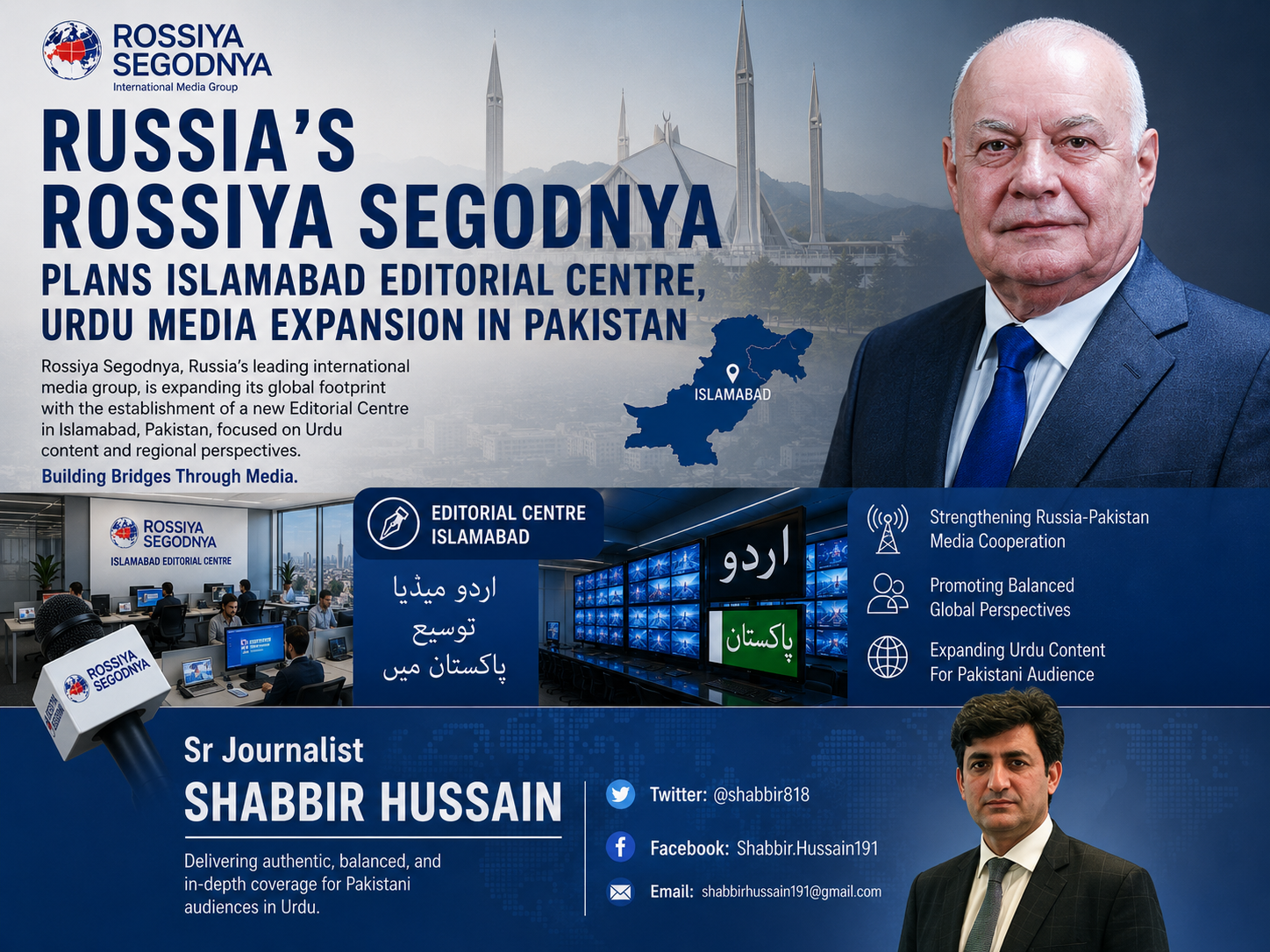
ISLAMABAD, Jun 28 (Alliance News):Russia’s international media organization Rossiya Segodnya is planning to establish a multi-purpose editorial centre in Islamabad along with expanding its correspondent network across Pakistan, marking a new phase of media cooperation between Pakistan and Russia.
Director General of Rossiya Segodnya, Dmitry Kiselev, said the organization was exploring new initiatives to strengthen its presence in Pakistan, including the launch of Urdu-language digital platforms, expanded news coverage, journalist exchanges, and stronger partnerships with Pakistani media institutions.
In an interview with a state-run news agency, Kiselev said the media group’s future plans were focused on increasing cooperation with Pakistani journalists and organizations while creating new opportunities for information exchange between the two countries.
The announcement comes as Rossiya Segodnya celebrates its 85th anniversary, with the organization highlighting international media cooperation as one of its key priorities. Kiselev said Pakistan remained an important partner and that the organization was committed to developing long-term professional relations with Pakistani media institutions.
He said the proposed editorial centre in Islamabad would help enhance coverage of Pakistan, regional affairs, and international developments while providing a platform for greater interaction between journalists from both countries.
Kiselev emphasized that Rossiya Segodnya aimed to expand its footprint in South Asia through multilingual journalism, modern digital platforms, and professional exchanges. He said the organization viewed media cooperation not only as a strategic connection but also as a way to promote direct communication and better understanding between societies.
He referred to the Moscow-Islamabad Media Forum as a major example of growing cooperation between the two countries. The forum brought together senior officials, diplomats, media professionals, and policy experts from Pakistan and Russia to discuss opportunities for collaboration in the information sector.
The Director General also highlighted existing Memoranda of Understanding (MoUs) signed with Pakistani media organizations, including Associated Press of Pakistan (APP), The Nation, and Pakistan Observer during previous engagements in Islamabad. He said these agreements provided a foundation for future cooperation, including content sharing, professional development, and joint media initiatives.
He noted that the presence of a permanent RIA Novosti correspondent in Pakistan reflected the organization’s growing interest in covering developments from the country and the wider region.
Discussing future cooperation areas, Kiselev identified direct exchange of news content, improved newsroom access, media forums, expert discussions, and joint projects on economic, scientific, and cultural issues as important fields for expansion.
He also proposed reciprocal journalist visits between Pakistan and Russia, saying such exchanges could help reporters gain deeper understanding of social, political, economic, and cultural developments in both countries.
Rossiya Segodnya, he said, was committed to providing international audiences with diverse perspectives on global issues. The organization operates through major brands including RIA Novosti and Sputnik, with journalists and correspondents working in various parts of the world.
Sputnik currently provides multimedia content in multiple languages, including news, radio, and digital services for international audiences. The media group has developed a broad network of partnerships with media organizations, universities, and research institutions across more than 100 countries.
Kiselev said the organization’s international strategy increasingly focused on regions including Asia, Africa, the Middle East, and Latin America, where demand for multilingual and digital journalism continues to grow.
He said modern journalism faced significant challenges, including misinformation, manipulated content, and deepfake technology. According to him, maintaining accuracy, credibility, and public trust remained among the biggest responsibilities of international media organizations.
He explained that Rossiya Segodnya had continued expanding its global operations through new editorial centres, correspondent offices, and broadcasting projects. Recent initiatives included strengthening media operations in different regions, launching new broadcasting services, and exploring additional opportunities across Asia and Africa.
The interview also highlighted the organization’s educational initiatives for journalists and media professionals. Since 2018, Rossiya Segodnya has operated SputnikPro, an international training program designed for journalists, media students, communication professionals, and digital content creators.
The program provides workshops, seminars, and lectures conducted by experienced media professionals. According to the organization, thousands of participants from different countries have benefited from the initiative.
Pakistani students and media professionals have also participated in SputnikPro activities, while a journalist from Associated Press of Pakistan recently attended a four-week professional training program in Moscow. Rossiya Segodnya expressed interest in expanding such opportunities for Pakistani journalists and media institutions.
Kiselev said South Asia was becoming increasingly important due to its population, economic growth, and expanding media landscape. He stressed that multilingual journalism would play an important role in supporting trade, education, cultural interaction, and people-to-people relations.
He said the organization was particularly interested in developing content in regional languages, including Urdu, Punjabi, Pashto, and Bengali, to reach wider audiences.
The planned Urdu-language platforms were described as a major priority for Rossiya Segodnya’s future activities in Pakistan and South Asia. The initiative aims to provide more localized content and strengthen communication links between Russian and Pakistani audiences.
The proposed Islamabad editorial centre and expanded correspondent network reflect Russia’s broader effort to increase media engagement in Pakistan while creating new platforms for journalism cooperation, knowledge sharing, and professional collaboration.


