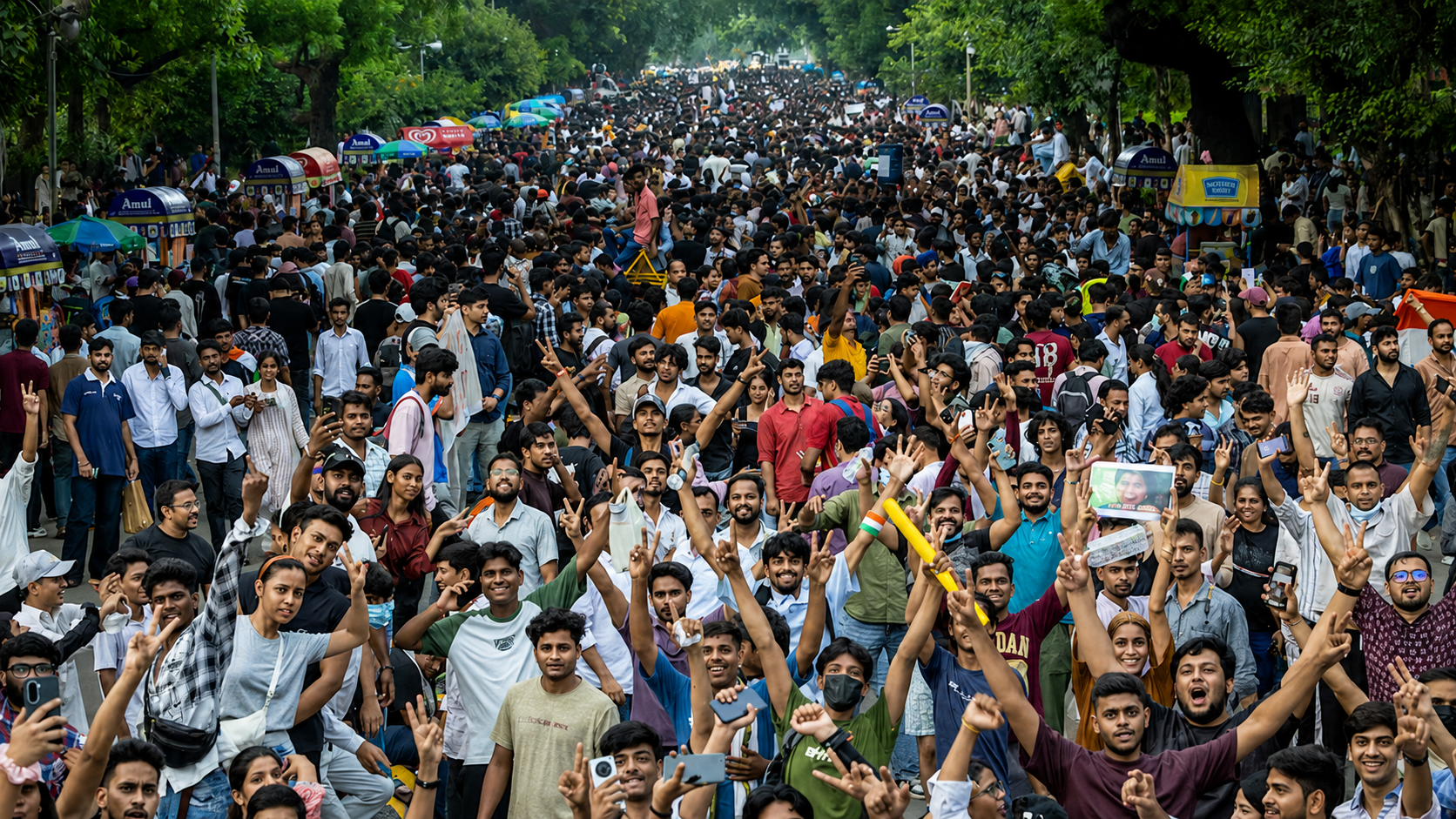
NEW DELHI, July 25 (Alliance News): India’s growing Generation Z movement, driven largely through Instagram, has emerged as an unexpected political force, posing one of the strongest public challenges yet to Prime Minister Narendra Modi’s leadership ahead of key state elections next year.
The movement, led by the youth-driven Cockroach Janta Party (CJP), began nearly five weeks ago with protests demanding the resignation of Education Minister Dharmendra Pradhan over alleged examination paper leaks affecting millions of students.
What started as an online campaign quickly evolved into nationwide demonstrations, with the CJP attracting more than 22 million Instagram followers within days and mobilising thousands of young protesters across major Indian cities.
Facing mounting public pressure, Prime Minister Narendra Modi posted a rare selfie video on Instagram, expressing concern over students’ grievances and assuring them that corrective measures would be taken.
However, the gesture failed to satisfy demonstrators, who continued their protests despite a heavy police crackdown in New Delhi and expanding demonstrations across several states.
The protests culminated in the resignation of Education Minister Dharmendra Pradhan on Saturday, fulfilling the protesters’ primary demand and marking one of the rare political setbacks for Modi’s government during his more than decade-long tenure.
Political analysts describe the development as a significant shift in India’s political landscape, where Modi and his Bharatiya Janata Party (BJP) have dominated national politics since 2014.
Anthropology professor Sanjay Srivastava of SOAS University of London said the movement reflected a broader change in public sentiment, with even some traditional BJP supporters questioning the government’s policies.
He noted that a much wider cross-section of society had begun questioning whether the ruling party continued to serve the country’s interests.
Although triggered by allegations of examination paper leaks, analysts believe the protests reflect deeper frustrations among India’s youth over unemployment, limited career opportunities and growing concerns that artificial intelligence could threaten jobs in sectors such as information technology and business process outsourcing.
Political analyst Amitabh Tiwari said the examination scandal merely acted as a catalyst for broader dissatisfaction among young people regarding their economic future.
Responding to the unrest, Defence Minister Rajnath Singh said the government’s priority remained addressing students’ legitimate concerns and ensuring their voices were heard.
Young Indians between the ages of 18 and 40 account for nearly 40% of the country’s population, yet hold only about 10% of seats in the lower house of Parliament, according to analysts, while the average age of India’s federal cabinet exceeds 60 years.
Although the CJP has repeatedly stated that it is not a political party, opposition groups have openly backed the student movement, hoping to capitalise on growing dissatisfaction with the ruling BJP.
Political observers believe the first electoral impact of the youth movement could be seen in next year’s elections in Uttar Pradesh, Punjab and Gujarat, where the BJP faces significant political tests.
Some analysts argue the larger challenge for Modi may emerge during the 2029 general elections should the CJP decide to enter electoral politics. Founder Abhijeet Dipke has so far said no decision has been taken regarding transforming the movement into a political party.
Observers also suggest India’s younger generation is gradually moving away from traditional voting patterns based on religion and caste, instead focusing on employment, education and governance issues.
The growing influence of social media, particularly Instagram, has accelerated this shift.
Author and political commentator Anurag Minus Verma said the BJP’s digital strategy remained largely centred on X (formerly Twitter), while political engagement among younger voters had increasingly migrated to Instagram.
The BJP currently has around 10 million Instagram followers, significantly fewer than the CJP’s 22 million, although Prime Minister Modi continues to command a much larger personal following across Instagram, X and Facebook.
Columnist Santosh Desai said Instagram rewards authenticity rather than carefully managed political messaging, making it a platform where younger audiences are more likely to challenge established political narratives.
For more than a decade, Modi has cultivated an image of strong and decisive leadership, rarely reversing major policy decisions. Analysts say the education minister’s resignation and Modi’s direct outreach to students may signal a more responsive political approach as public expectations evolve.