TEHRAN, Aug. 10 (Alliance News): Iran on Monday said the recently signed Makkah Joint Defence Agreement between Pakistan, Saudi Arabia and Turkiye reflects a changing regional perception of the United States, while stressing that Tehran does not view the trilateral pact as a threat to its national security.
Speaking at a weekly press briefing, Iranian Foreign Ministry spokesperson Esmaeil Baqaei said countries in the region had increasingly realised that lasting security could not be guaranteed by outside powers.
“The countries of the region have realised that security is not a commodity that can be bought from false brokers,” Baqaei said, in an apparent reference to the United States.
He added that regional states could no longer rely on Washington’s security guarantees in the same way they had in the past.
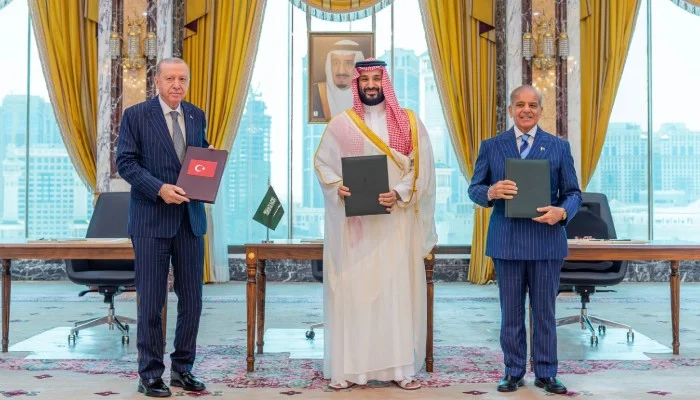
His remarks came days after Pakistan, Saudi Arabia and Turkiye signed the Makkah Joint Defence Agreement, under which an armed attack against any one of the three countries would be regarded as an attack against all.
The agreement was signed during the Makkah Al-Mukarramah Summit for Joint Defence, attended by Prime Minister Shehbaz Sharif, Saudi Crown Prince and Prime Minister Mohammed bin Salman, and Turkish President Recep Tayyip Erdogan.
The pact was concluded against the backdrop of the continuing US-Iran conflict, which has disrupted regional stability and affected maritime trade routes across the Middle East.
Despite speculation over the agreement’s strategic implications, Baqaei dismissed suggestions that the alliance was directed against Iran.
“There is no reason to worry that this treaty will be against Iran,” he said, highlighting Tehran’s “deep religious, historical and civilisational ties” with Pakistan, Saudi Arabia and Turkiye.
Analysts have suggested that the agreement aims to strengthen regional collective security and deterrence amid growing geopolitical uncertainty and concerns over the reliability of traditional security arrangements.
Pakistan’s Foreign Office has described the agreement as a demonstration of the three countries’ shared commitment to promoting regional peace, security and stability.
According to the Foreign Office, the agreement enhances defence cooperation across multiple sectors and establishes a framework under which any armed attack on one member state will be considered an attack on all three signatories.
Dar discusses defence pact with regional counterparts
Separately, Deputy Prime Minister and Foreign Minister Senator Mohammad Ishaq Dar held a series of telephone conversations with his counterparts to brief them on the newly signed defence agreement.
According to the Foreign Office, Kuwait’s Foreign Minister Sheikh Jarrah Jaber Al-Ahmad Al-Sabah congratulated Dar on the signing of the Makkah Joint Defence Agreement during a telephone conversation.
The two ministers also exchanged views on regional developments, including the situation in Occupied East Jerusalem.
Dar also spoke with Saudi Foreign Minister Prince Faisal bin Farhan, with both leaders discussing bilateral cooperation, multilateral engagement and regional developments.
The Foreign Office said both sides reaffirmed the importance of maintaining close coordination and cooperation at both bilateral and multilateral levels.
In addition, Dar briefed officials from Canada and the Republic of the Congo on the objectives and framework of the trilateral defence agreement.