
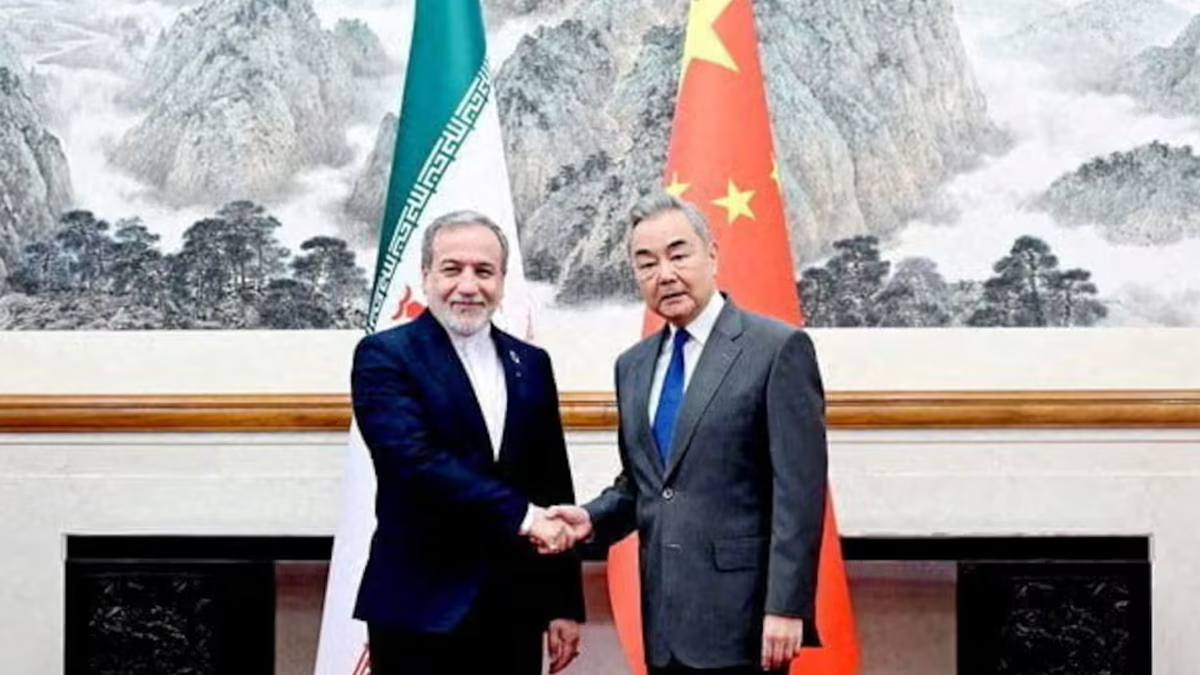
DUBAI, Sep 18 (Alliance News): China has privately asked Iran to help rein in Yemen’s Houthis following an appeal from Saudi Arabia after the Iran-backed group made rapid military advances in the past week, according to three Iranian sources familiar with the matter.
The sources said Riyadh turned to Beijing for help after Houthi forces made rapid advances along the Red Sea coast and around the Bab el-Mandeb Strait, increasing risks to Saudi oil exports and regional shipping.
China has publicly called for restraint, dialogue and the restoration of safe navigation, but its private message to Tehran went further, the sources said.
Beijing wants Iran to use its influence over the Houthis to help prevent the conflict from spreading further across key energy routes on which China, the world’s second-largest economy, depends.
The Iranian sources, who were briefed on the discussions and spoke on condition of anonymity, did not provide details on how the message was delivered or whether it was conveyed during Iranian Foreign Minister Abbas Araqchi’s visit to China on Wednesday.
According to the sources, Tehran responded that regional stability and peace depended on ending what Iran describes as the US-Israeli war against the country.
Chinese officials did not issue explicit threats or indicate that Beijing would seek to impose economic pressure on Tehran if it failed to use its influence over the Houthis, the sources said.
In response to a Reuters request for comment, China’s Foreign Ministry said Beijing did not want regional tensions to spill over further into Yemen and the Red Sea.
The ministry said escalating regional instability was not in the interests of any party and called for respect for the sovereignty and security of all countries, while urging an end to actions that could further complicate the situation.
Iran’s Foreign Ministry and the Saudi government’s media office did not immediately respond to Reuters requests for comment.
Dangers of a wider regional war
China has been Iran’s largest trading partner for more than a decade and remains its main oil buyer. Chinese purchases accounted for more than 80% of Iran’s seaborne oil exports in 2025, averaging about 1.4 million barrels per day, according to commodities data and analytics firm Kpler.
A senior Western diplomat in the region said Beijing was among the few capitals that could still pressure Iran to rein in the Houthis.
The Houthis emerged in the 1990s in opposition to Saudi Arabia’s Sunni religious influence in Yemen. Iranian and Western sources say the group is armed, trained and funded by Iran and forms part of Tehran’s broader network of regional allies.
Any threat to shipping in the Red Sea and through the Bab el-Mandeb Strait could further worsen the global energy crisis, particularly as Iran has also blocked the Strait of Hormuz.
With Hormuz already effectively shut, sustained Houthi attacks on vessels or ports in the Red Sea could disrupt two major oil-export routes simultaneously, adding pressure to global energy markets and increasing concerns over a wider regional conflict.
One of the Iranian sources said Iran and its allies now exert pressure over both ends of the region’s key maritime network, while noting that China depends on both routes.
Alex Vatanka, director of the Iran Program at the Middle East Institute in Washington, said Beijing may oppose US pressure on Tehran but has broader interests across the Middle East.
Roughly half of China’s oil imports come from the region, while annual trade between China and Gulf Cooperation Council states is around $300 billion, according to the report.
“Iran can disrupt Hormuz. But at some point that leverage begins hurting the very power Tehran increasingly depends on,” Vatanka said.
China’s dilemma
It remains unclear whether Tehran will act on Beijing’s concerns, according to the three Iranian sources.
China remains economically and strategically important to Iran as Tehran continues to face conflict with the United States and the impact of sanctions.
Beijing is among the countries with the financial capacity to provide investment needed to support Iran’s oil industry and ease pressure on its war- and sanctions-hit economy.
China has also demonstrated diplomatic influence in the region. In 2023, Beijing brokered an agreement that restored diplomatic ties between Iran and Saudi Arabia after years of hostility.
However, China’s influence has limits. Critics in Iran have complained about relatively modest Chinese non-oil trade and investment since the two countries signed a 25-year cooperation pact in 2021, particularly compared with Beijing’s growing investment commitments in Gulf Arab states.
China remains a factor Tehran cannot afford to ignore, but the Iranian sources said Beijing’s interests were only one consideration among competing strategic, economic and political priorities.
A Western diplomat said Tehran and Beijing needed each other, with China seeking the reopening of the Strait of Hormuz and secure shipping through the Red Sea.
Analysts say a key test will be whether China is prepared to attach consequences to its demands and use its economic and diplomatic leverage over Tehran.


