
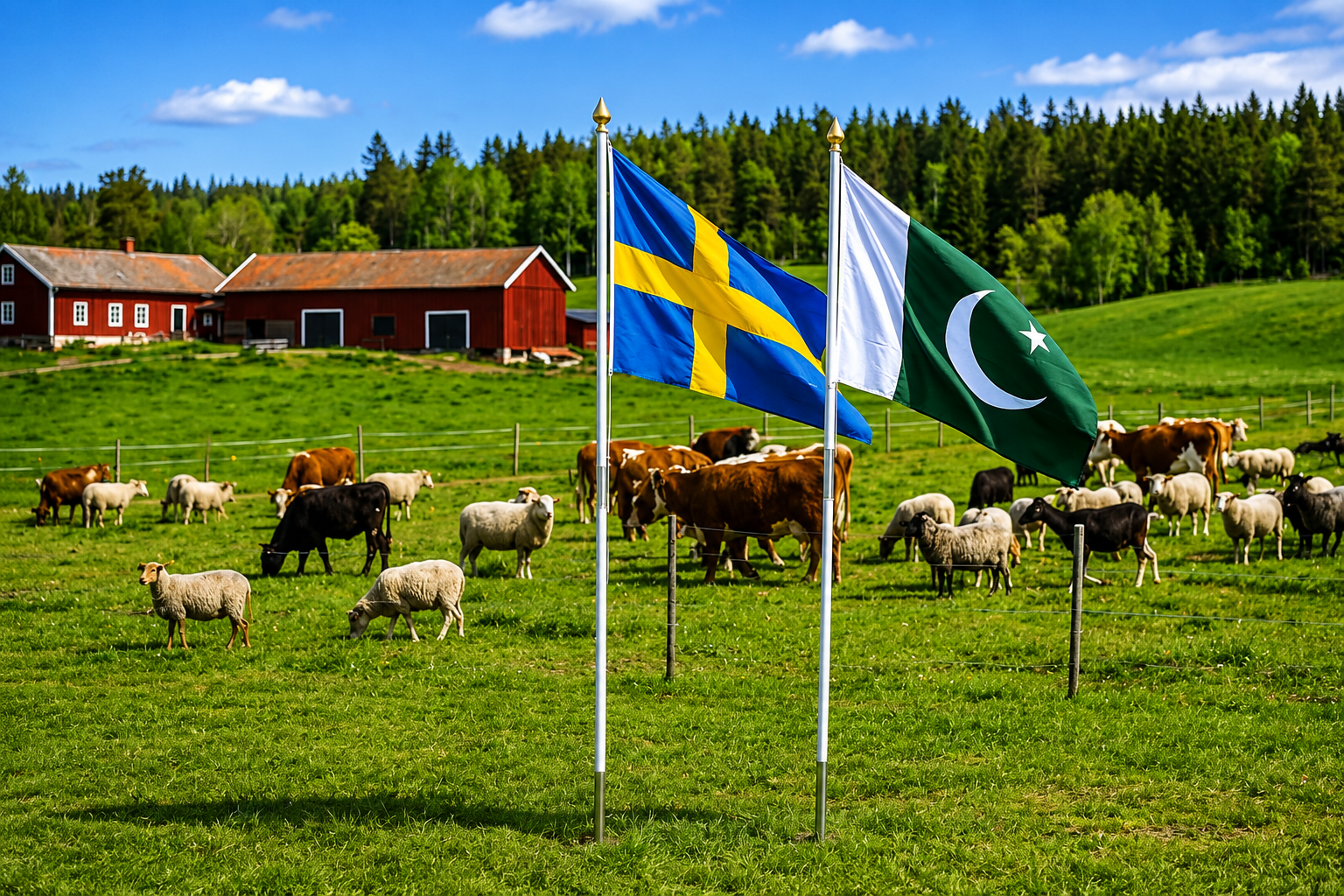
ISLAMABAD, July 18 (Alliance News): Pakistan and Sweden have agreed to strengthen bilateral cooperation in agriculture, food security, livestock, research, innovation and sustainable development, while Sweden expressed support for Pakistan’s enhanced role in global efforts to combat antimicrobial resistance (AMR).
The understanding was reached during a meeting between Federal Minister for National Food Security and Research Rana Tanveer Hussain and Sweden’s Ambassador to Pakistan, Alexandra Berg von Linde, who discussed expanding collaboration in key sectors of mutual interest and deepening institutional partnerships.
During the meeting, both sides reaffirmed their commitment to transforming the longstanding friendly relations between Pakistan and Sweden into a more comprehensive and practical partnership, particularly in agriculture and allied sectors.
Speaking on the occasion, Rana Tanveer Hussain said Pakistan is keen to broaden bilateral engagement with Sweden in agriculture, food security and rural development. He observed that despite the excellent political relations between the two countries, cooperation in the agricultural sector has remained below its full potential.
The minister highlighted Sweden’s global expertise in sustainable agriculture, climate-smart farming, food safety, livestock development, agricultural innovation and research, saying Pakistan is eager to benefit from Swedish knowledge, technology and experience.
He appreciated the contributions of the Swedish International Development Cooperation Agency (SIDA) in supporting global development initiatives and welcomed greater cooperation in professional training, technical assistance and capacity building for Pakistani experts.
Rana Tanveer Hussain emphasized the importance of strengthening institutional linkages between research organizations, proposing enhanced collaboration between the Pakistan Agricultural Research Council (PARC) and Swedish research institutions through joint studies, academic exchanges and technology transfer.
He said such partnerships would facilitate the exchange of scientific knowledge, modern agricultural technologies and best practices to support Pakistan’s efforts to modernize its agriculture sector, improve productivity and enhance climate resilience.
The minister also invited Swedish companies to explore investment opportunities in Pakistan’s agriculture, food processing, dairy, post-harvest management and value-added industries, noting that increased foreign investment would contribute to economic growth, job creation and higher agricultural exports.
Livestock development also featured prominently in the discussions, with both sides agreeing to promote cooperation in animal health, dairy production, food safety and sustainable livestock management to improve productivity and strengthen rural livelihoods.
A major focus of the meeting was antimicrobial resistance (AMR), which is increasingly recognized as one of the world’s most pressing public health challenges.
Ambassador Alexandra Berg von Linde formally encouraged Pakistan to seek membership in the Global Leaders Group on Antimicrobial Resistance, acknowledging the country’s growing efforts to address AMR through coordinated national policies.
She said Pakistan’s participation would strengthen the representation of the Eastern Mediterranean Region on the international platform while contributing valuable experience to global efforts aimed at combating antimicrobial resistance.
Welcoming Sweden’s support, Rana Tanveer Hussain said Pakistan would initiate the nomination process for membership of the Global Leaders Group on AMR.
He noted that the Ministry of National Food Security and Research is working closely with the Ministries of National Health Services and Climate Change under a coordinated national strategy to tackle antimicrobial resistance through a multi-sectoral approach.
Both sides reiterated their commitment to the internationally recognized “One Health” approach, which integrates human, animal and environmental health to effectively address emerging disease threats and antimicrobial resistance.
The discussions also covered the responsible use of antibiotics in human and veterinary medicine, strengthening regulatory frameworks, enhancing disease surveillance and promoting public awareness campaigns to safeguard public health and food systems.
The Swedish ambassador also highlighted the positive contribution of Swedish companies operating in Pakistan, particularly in food processing, dairy packaging, agricultural technology and sustainable textile production.
She said the successful presence of Swedish enterprises in Pakistan provides a strong foundation for expanding bilateral trade, investment and technology cooperation across multiple sectors.
The two sides also explored opportunities to strengthen collaboration in agricultural research, climate adaptation, innovation, digital technologies and sustainable food production to address common challenges posed by climate change and food insecurity.
They agreed that closer institutional partnerships, increased research collaboration and regular policy dialogue would help unlock new opportunities for mutually beneficial cooperation.
The meeting concluded with a shared commitment to deepen Pakistan-Sweden relations through sustained engagement, increased investment, research partnerships, knowledge exchange and stronger cooperation in agriculture, food security, livestock development and global health initiatives.


.)