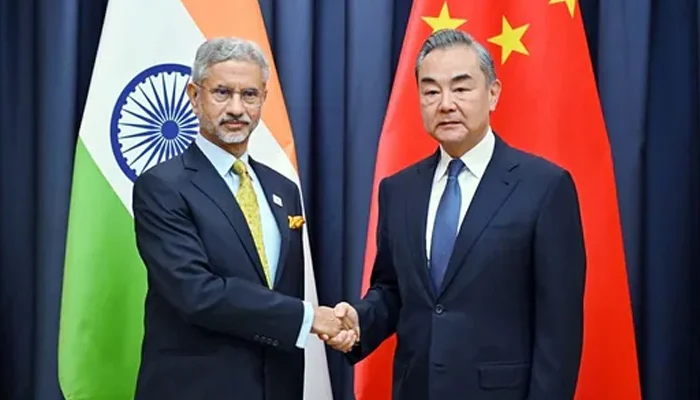
BEIJING, Jul 14 (Alliance News): India’s External Affairs Minister Subrahmanyam Jaishankar, during his first official visit to China since 2020, emphasized the urgent need to resolve ongoing border tensions and avoid restrictive trade measures in order to restore normalcy in bilateral relations.
Jaishankar met Chinese Foreign Minister Wang Yi in Beijing on Monday, reiterating India’s position that peace along the Line of Actual Control (LAC) is essential for broader diplomatic and economic engagement.
Referring to the positive developments over the last nine months, Jaishankar noted that recent progress had been made in reducing friction at the border, following the 2020 Galwan Valley clash that left soldiers dead on both sides and froze diplomatic ties.
However, he stressed that a full resolution was still pending. “It is now incumbent on us to address other aspects related to the border, including de-escalation,” he said.
India and China share a 3,800-kilometer undemarcated border that has been the subject of contention since the 1950s. Although several rounds of talks have taken place, a lasting agreement remains elusive. Indian Defence Minister Rajnath Singh also recently pushed for a “permanent solution” during a high-level military dialogue.
Jaishankar also raised concerns about China’s trade restrictions, particularly those involving critical minerals and high-tech manufacturing equipment, warning that such policies undermine the foundation for mutually beneficial cooperation.
The remarks come amid Beijing’s recent export curbs on rare earth materials and precision tools. India, despite holding the world’s fifth-largest reserves of rare earths, has yet to fully develop its domestic production.
The visit coincides with Jaishankar’s participation in the Shanghai Cooperation Organisation (SCO) foreign ministers’ meeting in Beijing. Earlier in the day, he also held talks with Chinese Vice President Han Zheng, who underscored the importance of advancing “practical cooperation” and respecting each other’s strategic concerns.