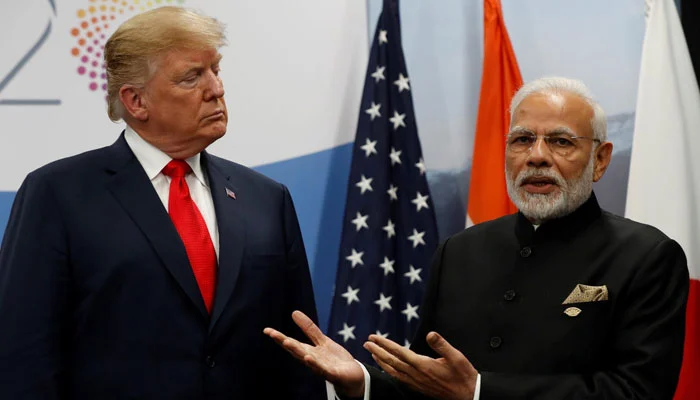
WASHINGTON, July 30 (Alliance News): Former U.S. President Donald Trump announced on Wednesday that the United States will impose a 25% tariff on imports from India starting August 1, citing India’s high tariffs and non-monetary trade barriers as justification for the move.
In a post on Truth Social, Trump stated, “While India is our friend, we have, over the years, done relatively little business with them because their tariffs are far too high, among the highest in the world.
They have the most strenuous and obnoxious non-monetary trade barriers of any country.”
Trump also mentioned an additional unspecified penalty on India to be implemented the same day, though he did not elaborate on its nature or amount.
The announcement threatens to derail recent progress in U.S.-India trade negotiations, where both sides had been working toward a limited trade agreement.
Multiple rounds of talks had been held to resolve disputes around market access for American agricultural and dairy products, but Indian officials remained firm on protecting the livelihood of millions of domestic farmers by restricting imports of items like wheat, corn, rice, and genetically modified soybeans.
India’s Commerce Ministry has not yet responded to Trump’s announcement.
The 25% tariffs are expected to significantly impact India’s goods exports to the U.S., which stood at $87 billion in 2024, including key sectors such as textiles, pharmaceuticals, petrochemicals, gems and jewelry.
Trump’s decision could also reignite trade tensions, as India considers possible retaliatory tariffs on U.S. manufacturing and energy exports, which reached $42 billion this year.
This move places India among a growing list of nations targeted under Trump’s “Liberation Day” trade policy, aimed at restructuring global trade by demanding greater reciprocity.
The White House had earlier warned India about its high tariffs — nearly 39% on average for agricultural imports, with some items like vegetable oils, apples, and corn reaching rates as high as 50%.
The timing is especially significant given previous joint declarations by Prime Minister Narendra Modi and Donald Trump, in which they pledged to conclude the first phase of a trade deal by autumn 2025 and expand bilateral trade to $500 billion by 2030, up from $191 billion in 2024.
With a current $45.7 billion trade deficit in favor of India, Trump’s move reflects growing protectionist sentiment and complicates a relationship that both sides had hoped to transform into a strategic and economic counterbalance to China.
Indian officials have repeatedly stressed that while they value the strategic partnership with the U.S., they must preserve sovereign policy space on matters such as agriculture, data governance, and state subsidies.