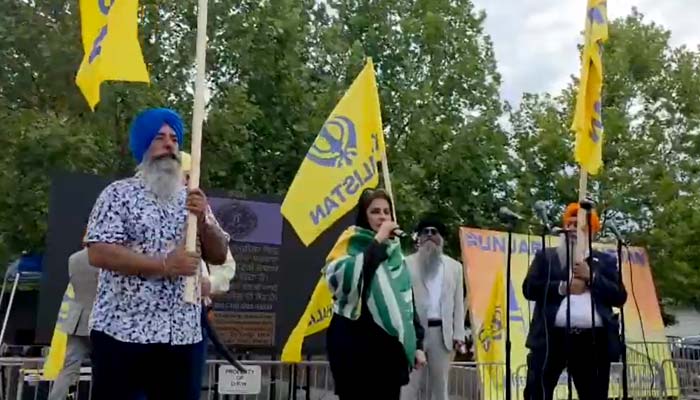
INDIANAPOLIS, Aug 18 (Alliance News): A referendum advocating the creation of Khalistan was held in Indianapolis, Indiana, with organisers claiming a large turnout despite rainfall as members of the Sikh community travelled from different cities and states to participate in the voting.
The referendum was organised under the auspices of Sikhs for Justice (SFJ), a group advocating the creation of an independent Sikh state of Khalistan in India.
Polling continued despite the rain, with women and families accompanied by young children among those attending the polling venue. Organisers said voting was scheduled to continue until 6pm, after which they expected to announce the final number of ballots cast.
Alongside slogans supporting Khalistan, some participants also raised slogans calling for freedom for Indian Illegally Occupied Jammu and Kashmir (IIOJK).
Ghazala Habib, chairperson of Friends of Kashmir, addressed the gathering and said she was the only non-Sikh speaker invited to speak from the stage. During her address, slogans supporting the freedom of IIOJK were also raised by participants.
Vikramjit Singh, who is associated with the Khalistan referendum campaign, told participants that the initiative was launched in 2020, but its activities were disrupted by the COVID-19 pandemic.
According to Singh, the first voting event was subsequently held in London on October 31, 2021. He claimed that thousands of Sikhs participated in that vote, although the figures cited by campaign organisers could not be independently verified.
Singh said referendum-related voting had since been organised in several countries, including the United Kingdom, Australia, Switzerland, Italy and Canada.
He said three referendum votes had been held in Toronto, while two were conducted in Vancouver and another in Calgary.
In the United States, Singh said similar events had previously been organised in San Francisco, Los Angeles and Washington, DC, with Indianapolis becoming the latest American city to host the referendum.
Singh claimed that around two million Sikhs worldwide had participated in the referendum campaign so far. The figure was presented by the organisers and could not be independently verified.
Addressing the gathering, Singh also accused the Indian government of historical injustices against the Sikh community. He referred to violence against Sikhs, the damage to the Akal Takht in 1984 and what he described as the exploitation of Punjab’s economic resources.
He argued that changes to India’s existing federal structure were necessary to address longstanding political grievances and promote lasting peace in the region.
Singh said the campaign sought to pursue its objectives through what organisers described as peaceful and democratic means. He called for a formal and binding referendum in Punjab whose outcome, according to the campaign, should have practical political consequences.
The organisers maintained that the referendum was intended to provide members of the Sikh diaspora with an opportunity to express their political views on the proposed creation of Khalistan.
The event also attracted attention because of the participation of families and community members despite adverse weather conditions. Organisers described the turnout as an indication of continued interest among sections of the Sikh diaspora in the Khalistan campaign.
However, the referendum is a campaign-organised vote and does not constitute an official referendum conducted or recognised by the Indian government or an internationally recognised electoral authority.
Organisers said further details, including the final number of ballots cast in Indianapolis, would be released after polling concluded.
They also said the next Khalistan referendum was expected to take place in Canada on October 18, although the information announced at the Indianapolis event did not clearly identify the Canadian city where the voting would be held.
The Indianapolis event comes as the Khalistan movement continues to generate political debate in India and among Sikh communities overseas. Supporters describe the campaign as a peaceful exercise of political self-determination, while the Indian government has strongly opposed separatist activities associated with Khalistan.