IRGC targets US military sites in Bahrain and Jordan as Trump says diplomatic deal with Tehran remains possible
By Shabbir Hussain
ISLAMABAD, July 14 (Alliance News): The United States launched a third consecutive night of military strikes against Iran, while Tehran responded with missile and drone attacks targeting American military facilities in Bahrain and Jordan, further escalating tensions across the Middle East despite President Donald Trump’s insistence that a diplomatic agreement with Iran remains achievable.
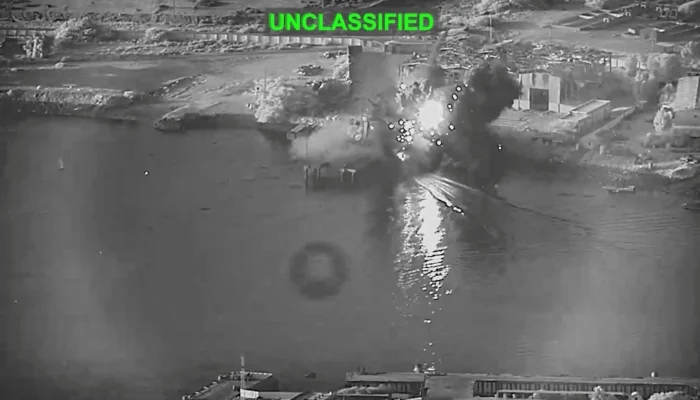
According to the US military, a five-hour operation struck multiple military targets in Iran, including facilities in Bushehr and Bandar Abbas, with Washington saying the attacks were aimed at degrading Iran’s ability to threaten commercial shipping in the Gulf.
Following the strikes, Iran’s Islamic Revolutionary Guard Corps (IRGC) announced missile and drone attacks against US military installations in Bahrain, including a residential complex used by American personnel, as well as other military facilities. Jordan also confirmed intercepting four Iranian missiles directed towards US-linked targets.
“We’re going to hit them very hard tonight, and we’re going to hit them hard tomorrow,” President Trump told reporters at the White House, signalling that US military operations would continue.
The latest exchange comes after a fragile ceasefire collapsed, reigniting fears of a wider regional conflict.
Trump also announced plans to reimpose a blockade on Iranian ports beginning Tuesday and proposed a 20% charge on cargo passing through the Strait of Hormuz, one of the world’s busiest energy shipping routes. The proposal has sparked criticism from Iran and raised concerns among global shipping and energy markets.
US Central Command (CENTCOM) said the blockade of Iranian ports connected to the Strait of Hormuz would take effect at 2000 GMT on Tuesday.
Oil markets reacted sharply to the renewed conflict, with crude prices rising more than nine percent on Monday before extending gains in Tuesday’s trading amid concerns over potential disruptions to global energy supplies.
Iran has also expanded its military response beyond Bahrain. The Revolutionary Guards said they targeted US military facilities in Jordan and urged Jordanians to demand the removal of American bases from their country.
Tehran earlier claimed responsibility for attacks directed at US interests in Bahrain, Jordan, Kuwait and Oman, while warning that any Gulf state cooperating militarily with Washington would be regarded as participating in the conflict.
Despite the intensifying military confrontation, President Trump maintained that negotiations with Tehran were still possible.
“I believe a deal with Iran can still happen,” he said, expressing hope that diplomacy could eventually bring an end to the conflict.
The White House also confirmed that Trump had formally notified the US Congress that military operations against Iran had resumed, giving the Pentagon authority to continue operations in the region for an additional 60 days without requiring further congressional approval.
In addition to the military campaign, Trump threatened possible action against Iran’s deeply buried nuclear facility near Natanz, alleging that Tehran continued to pursue undeclared uranium enrichment activities.
The proposal to impose a 20% cargo surcharge on vessels using the Strait of Hormuz has generated significant international debate. Trump declared that the United States would act as the “Guardian of the Hormuz Strait” and recover the costs of protecting commercial shipping through the strategic waterway.
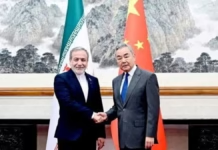
Iranian Foreign Minister Abbas Araghchi dismissed the proposal, responding sarcastically that while countries ensuring maritime security deserved compensation, Tehran would charge significantly lower fees if such a system were introduced.
International maritime experts note that international law generally prohibits countries from imposing transit charges solely for passage through international straits such as the Strait of Hormuz.
Iran’s Foreign Ministry acknowledged that the June memorandum of understanding, which had formed the basis for easing tensions and reopening negotiations with the United States, was now under severe strain.
Foreign Ministry spokesman Esmaeil Baqaei said the agreement was “in crisis” and warned that Iran would no longer consider itself bound by its commitments if Washington failed to honour its obligations.
However, Baqaei confirmed that Iran remained engaged in diplomatic contacts through mediators including Pakistan, Qatar and Oman in an effort to prevent the conflict from escalating further.
The latest military exchanges have heightened fears of broader instability across the Gulf region, with analysts warning that prolonged hostilities could threaten global energy security, international shipping routes and regional stability.