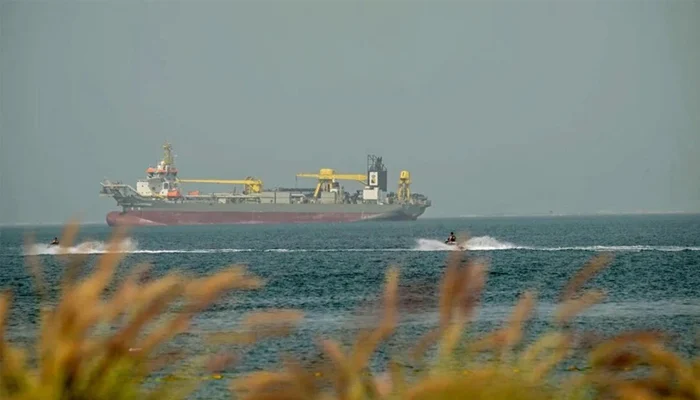
Dubai, March 8 (Alliance News): Around 1,000 cargo ships, oil tankers, and other vessels in the Gulf and Gulf of Oman are experiencing disrupted navigation due to GPS signal jamming amid the widening US-Israeli conflict in the region, experts say.
This represents roughly half of the vessels in the area, most of which are near the United Arab Emirates and Oman.
Analysts explain that most ships rely on the original civilian GPS signal (L1 C/A), which has not been upgraded since the early 1990s.
Unlike modern smartphones that access multiple satellite systems including Galileo, GLONASS, and BeiDou, many ships cannot switch to alternative networks when GPS signals are jammed.
The problem extends to aviation, where aircraft GPS receivers also remain largely limited to the L1 C/A signal.
Jamming disrupts location signals, while more sophisticated spoofing manipulates ships’ Automatic Identification Systems (AIS), potentially showing false positions on maritime trackers.
GPS is also critical for powering onboard clocks, radar, and speed logs, making safe navigation without it extremely challenging. Crews are forced to rely on older methods such as radar or visible landmarks, highlighting the vulnerabilities in maritime navigation.
Defensive GPS jamming is being used by Gulf states to protect against Iran’s drone attacks, a tactic previously employed by Israel and Iran during past conflicts.
While alternative navigation technologies using magnetic fields or inertial systems are in development, they remain largely experimental, leaving most ships heavily dependent on GPS.