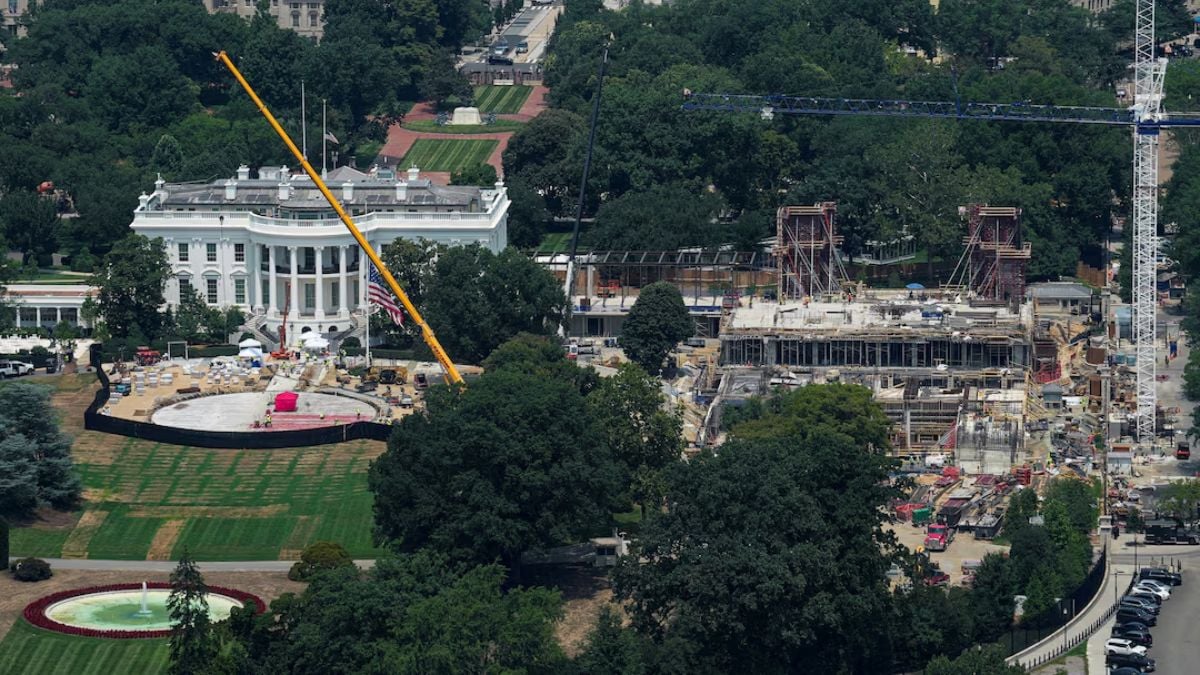
WASHINGTON, Aug 15 (Alliance News): US President Donald Trump’s administration has asked the Supreme Court to allow construction of a $400 million White House ballroom to continue while it challenges a lower court ruling that halted above-ground work on the project.
The Justice Department filed an emergency request on Friday, asking the Supreme Court to temporarily block the effect of a ruling by the US Court of Appeals for the District of Columbia Circuit while the administration prepares a full appeal.
The appeals court, in a 2-1 decision on August 7, upheld a lower court order requiring the administration to stop above-ground construction because the project had not received the necessary approval from Congress.
Justice Department lawyers argued that the ballroom is closely linked to presidential security and national defence requirements.
They described the proposed facility as a secure space that forms part of an integrated security complex at the White House and argued that halting construction could undermine national security.
The administration’s legal challenge follows the demolition of the White House East Wing and the beginning of construction of a planned 90,000-square-foot ballroom.
The National Trust for Historic Preservation filed the original lawsuit, arguing that the administration began the project without obtaining congressional authorization.
The appeals court rejected the administration’s position that national security considerations could justify proceeding without the required legal approval.
The court said national security arguments could not automatically exempt the executive branch from complying with the law.
The appeals court’s order does not permanently prevent the construction of a ballroom. Instead, it blocks above-ground construction until the administration obtains the required approval from Congress.
The appeals court had temporarily paused its ruling for 14 days, giving the Trump administration time to seek intervention from the Supreme Court.
The administration has argued that the proposed facility is necessary because of security threats against the president and other senior officials.
Trump has repeatedly defended the project, describing the planned ballroom as a major security facility rather than simply an event space.
In a recent post on Truth Social, Trump referred to the structure as a “military center” and criticised the appeals court decision as politically motivated.
He has also claimed that the proposed complex would include bomb shelters, medical facilities and protection against drones and missiles, alongside other security measures.
Trump argued that these facilities would be integrated into a single complex designed to protect the president, White House officials and visitors.
The National Trust for Historic Preservation, however, urged the Supreme Court to reject the administration’s request.
The organisation accused the administration of attempting to bypass legal requirements and limit judicial oversight.
The dispute has therefore developed into a broader legal battle over the limits of presidential authority, congressional control over major federal projects and the role of courts in reviewing executive decisions.
The Supreme Court’s response to the emergency request could determine whether construction proceeds while the wider legal challenge is considered.
For now, the appeals court order remains focused on above-ground construction and does not rule out the possibility of the ballroom being built if the administration secures the required congressional approval.