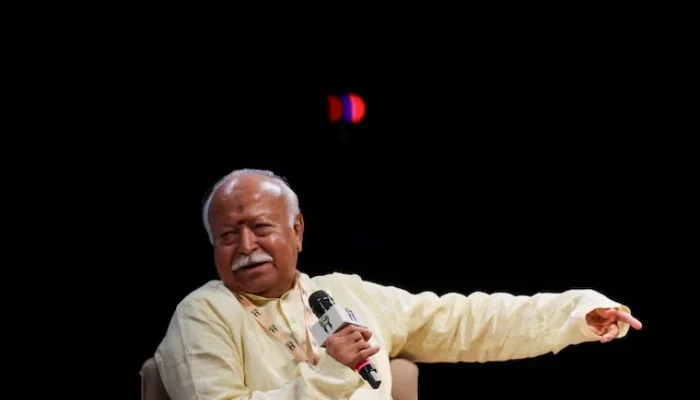
WASHINGTON, Aug 27 (Alliance News): A US panel on religious freedom has expressed concern over the US visit of Rashtriya Swayamsevak Sangh (RSS) chief Mohan Bhagwat and called for targeted sanctions against members of the Hindu nationalist organisation and Indian officials allegedly involved in religious freedom violations.
Bhagwat is currently visiting the United States and is scheduled to speak at an event in New York City on Saturday.
The RSS is a powerful Hindu organisation and is widely described as the ideological parent of India’s ruling Bharatiya Janata Party (BJP), from which Prime Minister Narendra Modi emerged as a leading figure.
The organisation said in May that it had organised foreign visits to counter perceptions that it is a paramilitary group involved in attacks on minorities.
“We urge the US government to consider targeted sanctions against RSS members and Indian officials complicit in religious freedom violations, including revoking the visa issued to Mohan Bhagwat,” Asif Mahmood, chair of the US Commission on International Religious Freedom (USCIRF), said in a statement on Wednesday.
USCIRF is a bipartisan US government body that monitors religious freedom worldwide and makes policy recommendations. Its recommendations are not binding, and Washington has not imposed sanctions following recent recommendations by the commission.
India’s foreign ministry has rejected USCIRF’s assertions, describing the commission as biased against India.
Rights groups have accused the RSS of promoting a majoritarian ideology that contributes to intolerance towards religious minorities. The RSS rejects the allegations and describes itself as a “Hindu centric civilisational, cultural movement” seeking to unite Hindus and take India “to the pinnacle of glory.”
The UN and human rights organisations have raised concerns over alleged abuses against Indian minorities in recent years, including increased hate speech and policies that critics say disproportionately affect Muslims and other minority communities.
They have also cited India’s religion-based citizenship law, demolition of properties owned by Muslims, the removal of the autonomy of Muslim-majority Kashmir and anti-conversion laws as issues affecting religious freedom and minority rights.
India’s BJP-led government denies discriminating against minorities and maintains that its policies, including food subsidy programmes and electrification initiatives, are intended to benefit people across all communities.