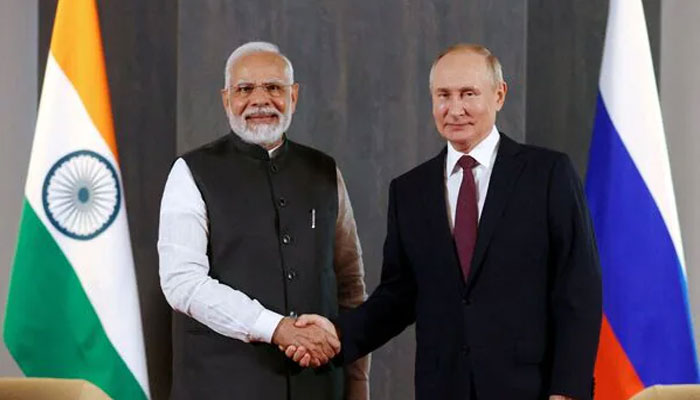
MOSCOW, April 18 (Alliance News) — Russia and India have reportedly signed a five-year agreement allowing limited deployment of military personnel and assets on each other’s territory, according to Russian media outlets.
Under the reported arrangement, each country would be permitted to station a capped number of military assets, including up to five naval vessels, ten fighter jets, and a maximum of 3,000 troops at any given time.
The agreement, as described in the reports, is being presented as a structured defence cooperation framework aimed at strengthening strategic and military ties between Russia and India over the next five years.
However, neither government has officially released detailed public documentation confirming the full operational scope of the deal.
According to the reports, the framework is intended to enhance interoperability between the armed forces of both countries, expand joint training opportunities, and facilitate coordinated responses in areas of mutual strategic interest.
Military analysts cited in Russian media suggest that the agreement reflects a broader effort by both sides to deepen long-standing defence cooperation.
The reported troop ceiling of 3,000 personnel is described as a rotational cap rather than a permanent deployment, with military units expected to operate under agreed-upon training, logistical, and operational parameters.
Similarly, the limitations on naval and air assets are said to be designed to ensure balance and transparency in deployments.
If confirmed, the agreement would mark one of the most structured bilateral military cooperation arrangements between Moscow and New Delhi in recent years, particularly in terms of reciprocal troop presence on each other’s soil.
Defence observers note that Russia and India have maintained a long-standing strategic partnership, particularly in the fields of arms procurement, defence technology transfer, and joint military exercises.
The latest reported development is being viewed by analysts as an extension of this broader strategic relationship into more operational military coordination.
However, the reported agreement also raises questions about its geopolitical implications, particularly in the context of shifting global alliances and ongoing security tensions in various regions.
Analysts suggest that such a framework could potentially signal an attempt by both countries to institutionalize defence cooperation at a time of increasing global uncertainty.
Neither the Russian Ministry of Defence nor India’s Ministry of Defence has issued a detailed public statement confirming the specific numerical limits or deployment terms outlined in the media reports.
Officials from both sides have previously emphasized that defence cooperation between the two countries remains strong and is based on longstanding strategic trust.
The reported arrangement also comes amid a broader trend of expanding military diplomacy globally, where countries are increasingly entering structured agreements for joint exercises, rotational deployments, and enhanced interoperability rather than permanent basing arrangements.
If implemented, the framework would likely require detailed logistical coordination, including command protocols, legal status of forces agreements, and operational guidelines governing the movement and deployment of personnel and equipment.
Security experts caution that while such agreements can strengthen bilateral defence ties, they also require careful management to avoid misunderstandings or operational friction, particularly when involving sensitive military assets such as fighter jets and naval vessels.
As of now, the agreement remains reported in nature, with further official clarification expected from both Moscow and New Delhi in the coming period.