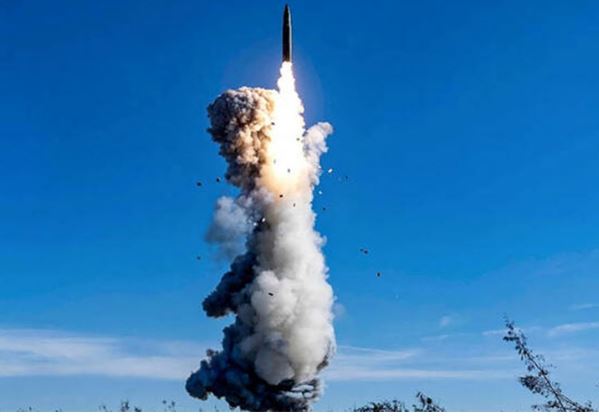
WASHINGTON, July 7 (Alliance News): The United States on Monday expressed concern over China’s expanding nuclear programme after Beijing test-fired a dummy intercontinental ballistic missile (ICBM) warhead into the Pacific Ocean, describing the move as part of an opaque military build-up.
The missile test, conducted as part of China’s annual military training, came two years after Beijing launched an intercontinental ballistic missile over international waters near French Polynesia, the first such launch in more than four decades.
US State Department spokesperson Tommy Pigott said China’s growing nuclear arsenal was a matter of serious concern for both the region and the international community.
“At a time when the United States is working harder than ever to prevent nuclear proliferation, China is doing the opposite,” Pigott said.
He urged Beijing to participate in meaningful arms control negotiations and establish a regular notification mechanism for all intercontinental ballistic missile and space launches.
The latest launch comes after the United States allowed the New START nuclear arms control treaty with Russia to expire earlier this year while seeking a broader agreement that would also include China.
Beijing has repeatedly rejected calls to join such negotiations, maintaining that its nuclear arsenal remains significantly smaller than those of the United States and Russia.
Chinese Navy spokesperson Wang Xuemeng said the missile launch was a routine military exercise conducted under the country’s annual training programme. He added that relevant countries had been informed in advance.
New Zealand confirmed that Pacific nations received notification approximately two hours before the launch, although it remains unclear whether the United States was informed beforehand.
According to defence analysts, the missile, believed to have been launched from a Chinese nuclear-powered submarine, landed near the Solomon Islands, highlighting China’s growing sea-based nuclear capabilities.
Lyle Morris, Senior Fellow at the Asia Society Policy Institute, said the test demonstrated China’s increasing ability to deploy long-range nuclear deterrence from submarines, significantly enhancing its strategic reach.
He noted that the capability could enable China to target the continental United States while operating closer to its own territorial waters.
The missile test coincided with Australia and Fiji signing a new defence agreement aimed at strengthening regional security cooperation in the Pacific.
Australian Foreign Minister Penny Wong described the Chinese missile launch as “destabilising” for the region, while Japan said it had received advance notification but remained seriously concerned about China’s expanding military activities.
Japan urged Beijing to reconsider such actions amid growing regional tensions, particularly over Taiwan and security issues in the Indo-Pacific.
Meanwhile, Russia defended China’s actions, saying the missile test was Beijing’s sovereign right and insisting that China posed no threat to other countries.