TRISHULI, Aug 27 (Alliance News): Rescue teams in Nepal continued searching for survivors on Thursday after a massive landslide sent mud, rocks and floodwaters through towns and valleys near the border with China’s Tibet, killing at least 162 people.
Authorities said nearly 1,500 people were missing across Nepal and Tibet, including more than 700 foreign nationals. Officials warned that the death toll could rise as rescue teams recover more bodies from areas buried under mud and debris.
Nepalese police spokesperson Abi Narayan Kafle said the number of confirmed deaths was expected to increase as search operations resumed in the worst-hit areas.
In Nepal, 826 people were reported missing, including almost 500 foreigners, according to police and tourism officials. Among the missing foreign nationals were 177 from India, 63 from the United States, 34 from Australia, 33 from Britain and 25 from Canada.
Nepal tourism officials separately reported more than 400 foreigners among 579 missing tourists, many of whom were travelling through the region for trekking and pilgrimage.
In China’s Gyirong county in Tibet, 558 people were reported missing, including 260 foreign nationals, according to Chinese state broadcaster CCTV. China reported three deaths in the affected area, although officials said figures were still being verified.
The disaster occurred after a massive wall of mud and rock collapsed into a river near the Himalayan border, triggering destructive floods and debris flows downstream.
Verified footage showed torrents of water, mud and rocks sweeping through a border crossing, destroying homes, roads, vehicles and infrastructure.
Survivors described being forced to flee rapidly as floodwaters and debris engulfed their homes.
One survivor, Keshav Prasad Baral, said he attempted to save his wife by taking her to higher ground, but she was swept away by the mud.
Emergency relief operations
Nepalese military helicopters have been deployed to search for missing people and rescue stranded residents while also delivering tents, food and other emergency supplies.
Nepal Army spokesperson Raja Ram Basnet said helicopters were dropping relief supplies provided by neighbouring India in some of the worst-affected districts.
Initial reports had suggested that an earthquake might have triggered the collapse of a glacier or rock formation. However, the US Geological Survey later said the seismic signal was generated by the collapse of glacial rock and ice, followed by a debris flow.
Satellite imagery indicated that a landslide involving ice and rock unleashed a flood carrying large quantities of debris into the Lhende River, about 20 kilometres northeast of the Nepal-China Rasuwagadhi border crossing.
Foreign nationals among missing
The disaster has affected tourists and workers from several countries.
South Korea said eight nationals working at a hydropower project were missing, while Malaysia and Japan also reported missing nationals.
Australia confirmed that 34 Australians were among those unaccounted for.
US authorities said Washington was sending a disaster response adviser and providing $500,000 in assistance.
Canada’s Prime Minister Mark Carney described the floods as devastating, while the United Nations said teams and partners were sending supplies and personnel to support affected communities.
Many victims were travelling to Kailash Mansarovar, a high-altitude pilgrimage destination in Tibet revered by Hindus, Buddhists and followers of other faiths.
Widespread destruction
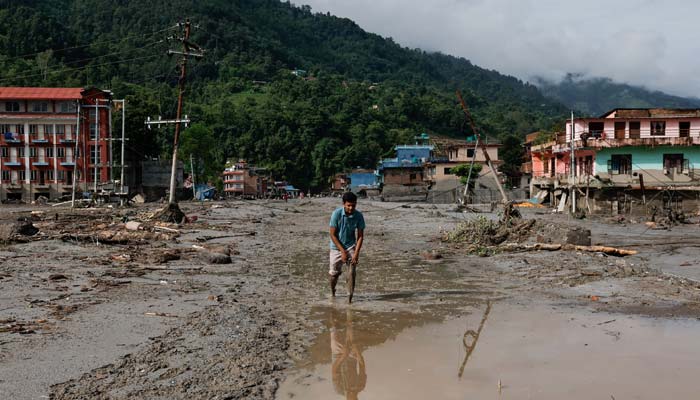
In the hardest-hit areas, thick layers of mud covered homes, trees and vehicles. Roads, bridges, power facilities and communications infrastructure were damaged or destroyed.
Television and drone footage showed collapsed buildings, vehicles swept away by floodwaters and a metal bridge destroyed by the torrent.
Tula Bahadur BK, a health worker in Rasuwa, said entire settlements along the river had been swept away and five of his relatives remained missing.
China’s Xinhua news agency reported that the mudslide struck the Gyirong port, cutting roads, communications and power links in the Shigatse border region.
A drone inspection showed that roads leading to the border crossing had been completely destroyed, making rescue and relief operations difficult.